Yogi Yasha

The Megalithic Depository
Information and Conditions for a Megalithic Depository for a Global Village
Copyright © 2021, Megalithic Depository, all rights reserved. Patent Pending, Member of the United Nations WIPO
In response to historical and contemporary global events, the idea of storing our knowledge for future generations seems logical and prudent. A consistent and historical problem of information management is its falsification or distortion by contrary, even delusional, opinions. The intentional destruction and burning of libraries and historical places have been the primary cause of information loss.
A Proposal for a Megalithic Depository
In an era of cultural absolutism, those who possess the ability to act have a responsibility to act, regardless of the consequences. It is essential to establish reliable information storage that is difficult or unlikely to be destroyed and will survive for thousands of years without maintenance. There are additional problems associated with natural disasters, including earthquakes, volcanic eruptions, asteroids, sea-level rise, ice ages, glacier migration, and the actions of uninformed individuals.
We need a Megalithic Depository for a Global Village compiling historical and contemporarily relevant information for these reasons:
-
Many historical artifacts are difficult to interpret symbolically because of their context. Some examples include stupas, mandalas, temple complexes, statues, figurines, texts, and funeral objects, among many others. Many of these artifacts refer to myth stories, historical events, or possibly helpful insights and knowledge that are forever lost.
-
The world population is currently decreasing and will likely continue to do so for the next 100 years or so. Eventually, the world's population will stabilize at some unknown sustainable level. Will there ever be a time when there are not enough people to manage all the information, including art, artifacts, literature, and everything else, let alone protect this information from contrary opinions?
-
We have been miniaturizing information into smaller and smaller spaces where availability is reliable and consistent. Unfortunately, what has also changed, often and problematically, are the complicated access tools. There are historical examples of more durable solutions.
-
Replication and redundancy are crucial for preserving information. Currently, historical data is publicly available and maintained. The public updates and replaces this information as necessary.
-
An alternative preservation strategy is a Megalithic Depository, constructed in stone or glass, with access that makes the destruction of the information significantly more difficult and requires a high level of sophistication, which is hopefully not what they are interested in doing.
-
Artificial Intelligence will pose problems in many unexpected ways. Unintended consequences and collateral damage are a natural outcome of these accumulated efficiencies. Good outcome events are also possible. AI is beneficial in unimaginable applications. Hopefully, AI would not be interested in destroying information carved in stone or glass.
-
The Internet and AI are astonishing in durability, diversity, and availability of information, but vulnerabilities include easy manipulation, access tools, and viruses. We are currently experiencing a pandemic of a human virus. What if a virus escaped that had a 99% mortality rate? What if some young hacker killed 99% of the internet solely to see if they could do so?
This Megalith Depository is not proposed as a public museum, but rather as a reference depository—a Rosetta stone that includes texts, pictures, bas-reliefs, diagrams, and more. Imagine meter-wide corridors with walls of one-meter-thick granite, carved into interlocking stone, featuring small laser-carved script extending three meters high for kilometers. I can imagine an extensive labyrinth of such galleries. This gives full access to the smallest accessible space. Such narrow, convoluted corridors make it challenging to bring in large enough equipment to cause significant damage.
A Megalithic Depository Using a Labyrinth
The basic building blocks are arranged in a labyrinth, allowing easy access to the information carved into them. Each floor can have different labyrinth designs. Part of the Labyrinth will be closed off and hidden for long-term durability. Another strategy is to fill enclosed corridors with clean sand to absorb kinetic energy and serve as a time capsule.
The labyrinth can be organized into compartments per section. An example is one section that might be separated into four categories: Medicine, technology, science, and sociology. An adjacent area might be categorized into four sections: religion, games, entertainment, and fiction.
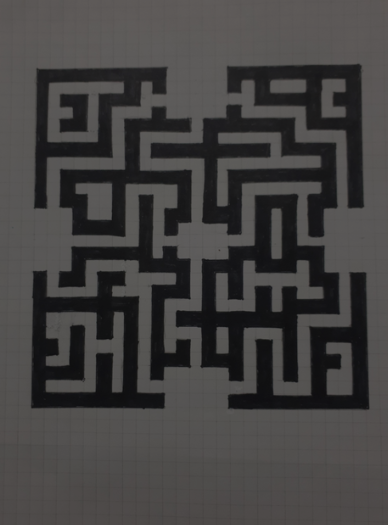
I propose that there be four entrances in the center of each labyrinth's exterior wall face. The entrance hall might be 10m x 10m square with doorways into the maze in each of the three enclosed walls. The right-hand corridor would lead to the left-hand door on the adjacent wall. This corridor should have no crossing passages that could lead people astray, so that walking far enough will always lead to an open doorway. This passage corridor should be less than one km long. The secure access corridors can include sand for kinetic energy absorption or for storing time capsules.
Conclusion
It is possible to build a Megalithic Depository, piece by piece. This proposal to construct a megalithic monument, following 5000 years of human history, requires a compelling reason to do so. I contend the reasons are self-evident, obvious, and persuasive. Failing to do so could easily constitute institutionalized communal unconsciousness.