Yogi Yasha

The Tambolian Map Society
The Tambolian Map Society is a contemplative spiritual and esoteric layman community that promotes Applied Paleography, a study of pictographic learning protocols - The Tambolian Map
The social structure of the Tambolian Map Society is as follows:
-
The Tambolian Society is administered by the First Speaker.
-
Participation in the Tambolian Map Society is by application and invitation.
-
The First Speaker may amend rules and doctrines with a simple majority of the Fair Witnesses.
-
Citizen - Must petition for citizenship in the Tambolian Map Society, which will be accepted with consensus by a simple majority of citizens.
-
Facilitator - Must petition for recognition as a Facilitator and will be accepted with the consensus by a simple majority of Facilitators.
-
Hermit Mystic - must petition for recognition as a Hermit Mystic and will be accepted with the consensus by a simple majority of Mystic Hermits.
-
Pilgrim Wanderer - Must petition for recognition as a Pilgrim Wanderer and will be accepted with the consensuses by a simple majority of Pilgrim Wanderers.
-
Teacher Friend - Must petition for recognition as a Teacher Friend and will be accepted with the consensus by a majority of Teacher Friends.
-
Shaman Healer - Must petition for recognition as a Shaman Healer and will be accepted with the consensus by a majority of Shaman Healers.
-
Fair Witness – Must petition for recognition as a Fair Witness and will be accepted with the consensus of a majority of Fair witnesses and the approval of the First Speaker.
-
The First Speaker – there will only be one first speaker whose successor will be chosen by the First Speaker.
By-laws
The objective of the Tambolian Map Society is to introduce to the secular public a Mystical Map with historical lineage through the Tibetan Mahayana tradition and the teaching of ancient mystical and insight practices. This idea was proposed by Ralf Honda, President of the Young Buddhist Society, in Honolulu in 1977. His insight was that a Layman’s Esoteric Society was needed.
The Long Chen Nying Tigue Visualizations
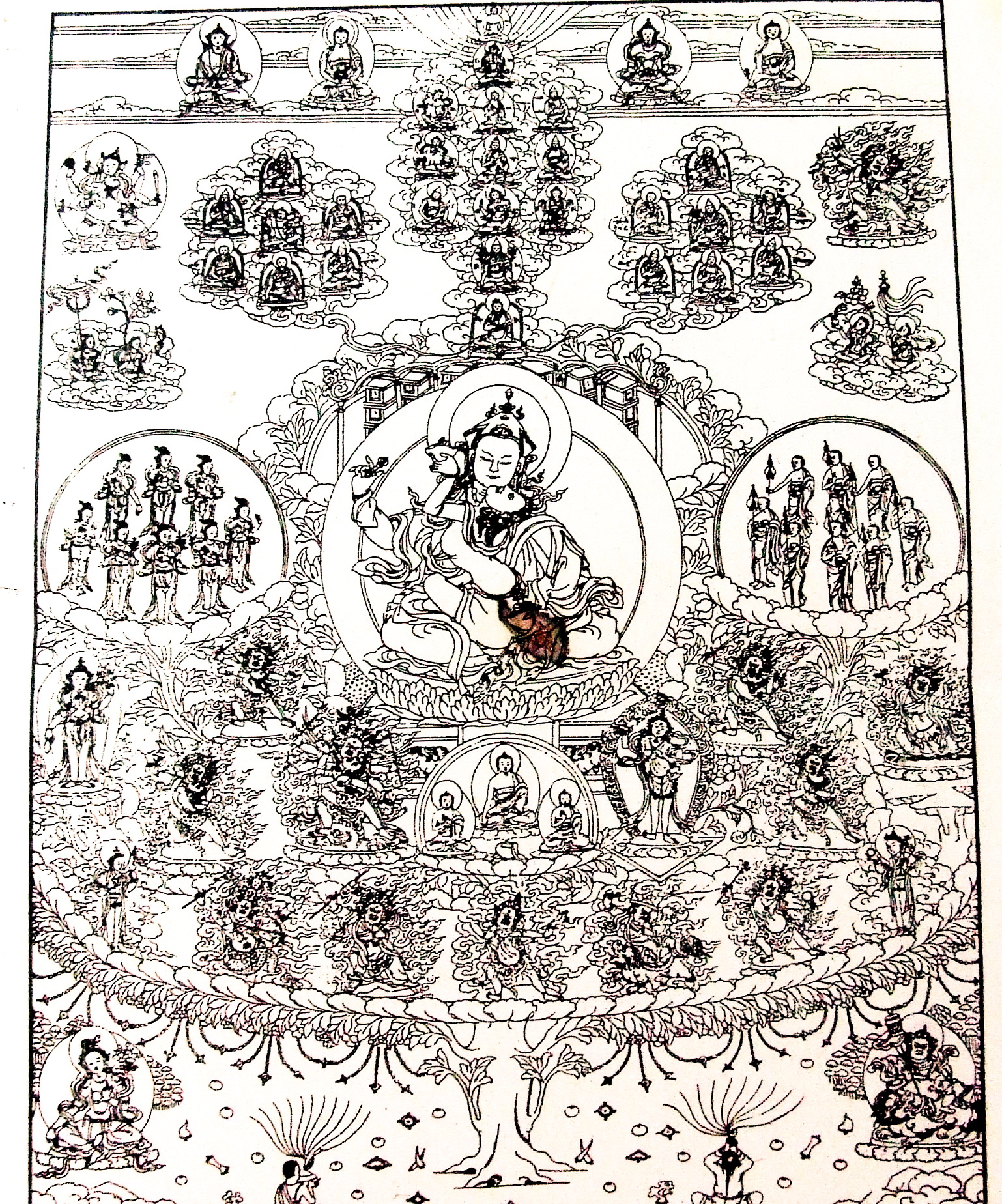
I moved into Padma Ling Monastery in the summer of 1971 with Tarthang Tolku Rinpoche and began formal practices. It was a frenzied time in a frenzied year in the heart of the hippy revolution at Berkeley, California. The Padma Ling Monastery is a converted fraternity house five blocks east of Telegraph Avenue, arguably the most berserk place on the planet. Within a few weeks of living in the basement, in a closet under the stairs leading to the meditation and ceremony room, I decided to acquire the Longchen Nyingtik Refuge Tree Visualization.
I noticed that other students had this enigmatic pictograph on their altars and were unfamiliar with the standard Tibetan protocols in such matters. I snuck into the ceremony room when no one was around, rummaged under the altar until I found the stack of visualizations, and snatched one as clean as the Artful Dodger in any Dickens novel. I shortly discovered that this was a serious breach of meditational and spiritual integrity, but I kept the Visualization anyway.
A few weeks later, Tarthang Tolku Rinpoche visited me in my little closet room. This was not as easy as it might seem. I lived in the basement of a large fraternity house that had been converted into a meditation center. To get to my room, you had to know the right hallways, go through the correct doorways, and navigate around some basement storage areas, all of which made about half the journey in complete darkness, even during the daytime. We, as students, were supposed to be up at 6:00 am to attend the morning practices in the ceremony room at 6:30 am. Tarthang arrived at my room at 5:45 am and caught me sitting in the half lotus, with my altar correctly set up, with a candle burning in a proper dish and incense in the appropriate sand holder, chanting away like a mad mendicant. I'm not sure what he was expecting to find as the door banged open, and Tarthang, being a large man, filled up the closet and then some. He took a quick look around, saw the Refuge Tree visualization, among other things, and said a "Harrumph" kind of sound, implying, I suppose, no justifiable reason for yelling at me, and banged out again.
For the next few years, I mostly stayed at Padma Ling Monastery between trips to the desert. Gyaltrul Rinpoche was also living in Padma Ling at that time. We seemed to get along quite well, and he ultimately tested me on the symbolism of the Longchen Nyingtik Refuge Tree visualization.
I was never sure why no one at Padma Ling or anywhere else seemed interested in this remarkable pictograph. I loved it from the beginning; I was utterly fascinated by what eventually evolved into a sophisticated arrangement of symbol strings, algorithms, and abstract decision-making protocols and outcome management strategies.
Initially, the Longchen Nyingtik Refuge Tree pictograph appears to be an organization of the historical lineage of the Dzogchen Masters in the form of a refuge tree. This Tree, a possible depiction of the Bodhi Tree at Bodhi-Gaya, India, is the primary structure typical of all Mahayana Buddhist lineage visualizations. Branches lead to Monks and Bodhisattvas, Yoga Masters, mediators, billowy clouds, banners of victory, an upside-down rainbow, and other peaceful/wrathful deities floating independently here and there. At the outset, the pictograph seemed artfully stylized, historically complicated, and conceptually tedious. Until I thought about it for a while, it was just interesting. Then it became infinitely fascinating. An esoteric plan represented my spiritual journey, morphing into a mapping algorithm of my conceptual mind, then into a convincing argument for enlightened awareness, and finally into a panoramic vista of the human condition.
For me, this was a thoroughly compelling realization process, utterly fascinating, addictive, and persuasive. I asked Gyaltrul Rinpoche to test me on this process sometime in 1975. We were in Oakland, California, at the time, and after my explanation, he said that I had passed the test, but I figured it out too fast. I asked him again to try to understand what he meant, "Had I actually figured out the symbolism of the Refuge Tree visualization?"
"Yes," he said, then emphasized, "But you did it too fast!"
Figuring out the Refuge Tree visualization was easier than figuring out Gyaltrul Rinpoche's answer. To this day, I haven't the foggiest clue about what figuring out something too fast might mean. That I was able to unravel this Refuge Tree visualization enabled me to pass the Insight Test given to me by the Supreme Patriarch of Thailand a few years later, which, of course, led me to the Forest Monks in northern Thailand and eventually a sunny cave in the Superstition Mountains in Arizona.
An anecdote reveals another unusual connection between this particular Refuge Tree lineage visualization pictograph and Gyaltrul Rinpoche, who traveled to Berkeley, California, via Belleville, Canada. He came as the official Lama for fifty Tibetan families, sponsored by the Canadian Government's graciousness. Occasionally, I had to take him back there to visit his traditional parishioners. We usually stayed at the hectic home of Nurup Rongue, the son-in-law of the King and Queen of Kam, Tibet (The King and Queen of Kam, Tibet, look exactly like the King and Queen on a deck of cards).
One afternoon, I was asked to take a blanket outside to Nurup's father, Tenzin, who had recently moved into the house. He was sitting under a tree in the backyard. I remember giving him the blanket, then lying beside him and falling fast asleep, an odd behavior for me.
Tenzin came into my room a few days later and noticed the Refuge Tree visualization. He became quite agitated; he left and brought back his son to translate his concerns. Tenzin said he was the original artist of this particular Refuge Tree visualization, which he had drawn in Kam Tibet twenty years or so earlier, and asked how I had come to possess it. I said that I got it from Tarthang Tolku Rinpoche. He immediately said that Tarthang had stolen it from him in Damansara, India. I told them both how I had stolen it from Tarthang. Tenzin's eyes glistened with the most conspiratorial laughter I had heard, maybe ever.
We all laughed for a while, then went out for some tea.
The Bhavaha Chakra
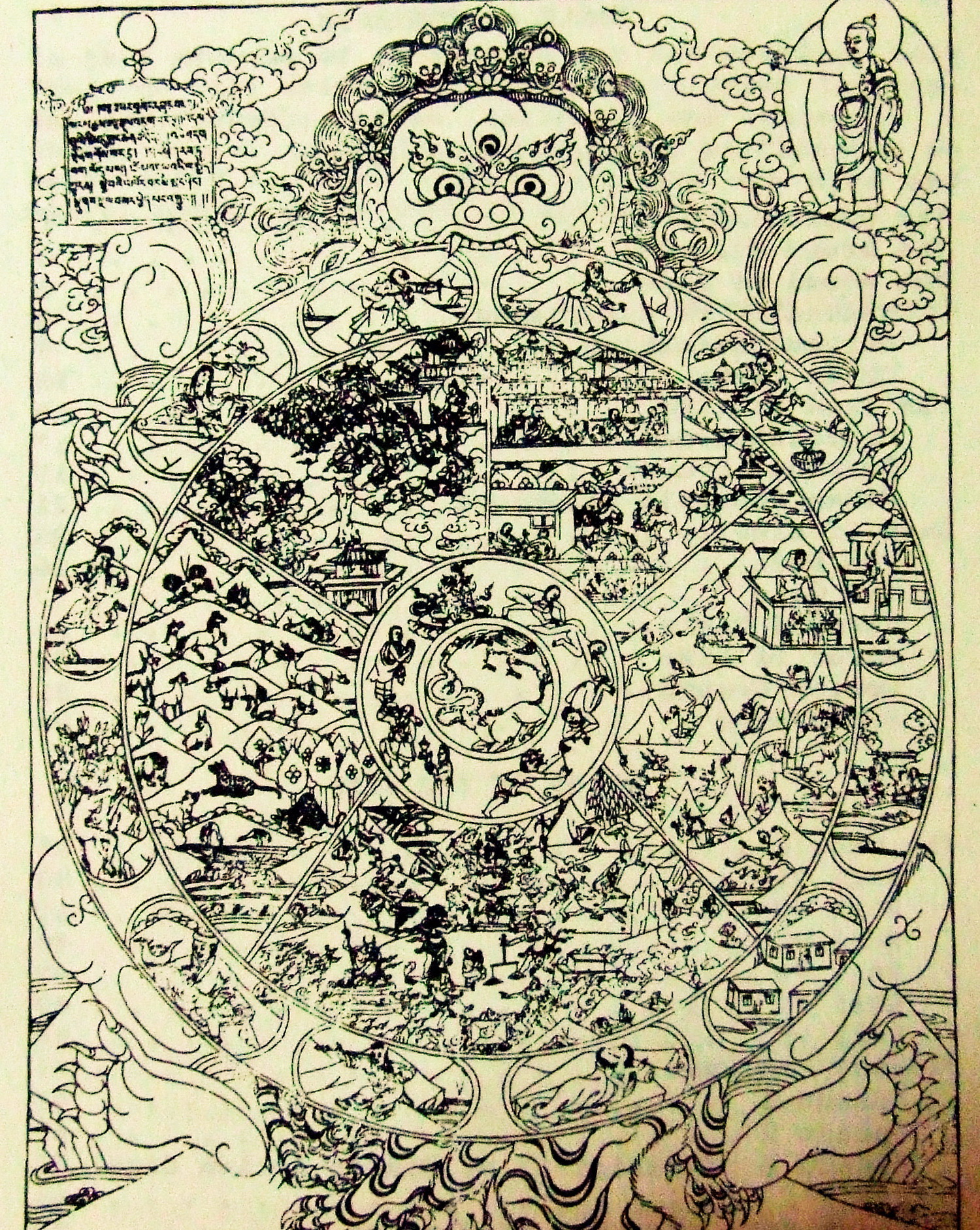
Cause and effect are undecidable. What we have access to are conditions and information. The problem is deciding what the information means.
The Primary Motivation starts at the center of the Wheel of Life. The colors are an adaptation from the five elemental families: Earth (Green), Air (Yellow), Fire (red), and Water (Blue). Either is the fifth component, and the color white, hidden and not included, is applied as a characteristic of the original unconditioned background.
-
Balance (Blue): You are primarily in Balance until you want to accomplish a specific task. What the Tambolian Map does is explain in what way you are out of Balance. Occasionally, Balance is the problem. Other times, it is the objective.
-
Emotion (Green): Emotions are located in your heart space and are mostly how you perceive yourself and how you want others to see you. Too much or not enough can both be problems.
-
Deception (Yellow): Deception is your head and the thinking, analytical part of your brain. It is pretty rare not to be deceiving yourself.
-
Desire (Red): Desire is the lowest part of your body. Desires are usually simple and easy to identify. Unfortunately, desire does not go away easily, either.
What the Tambolian Map does for spiritual pilgrims and contemplatives is to organize the accumulated influences that make up the human condition into a single pictograph. The early Buddhist Mahayana practitioners noticed that the symbolic structure of the Wheel of Life, combined with the Tree of Life visualization, encompassed all the initial conditions.
The initial epiphany was recognizing that the photographs in the original mandala structures were not simply artistic style and symbolism but an efficient organization. This sophisticated insight into a symbol string process duplicates paleographic documentation. I contend it is more efficient once the process is understood. The Bhavacakra, Wheel of Life, is the organization of the initial conditions recognized by early Mahayana, but it has been stylized into myth and aphorisms that have little meaning or are completely misunderstood or mistranslated in contemporary times. The current problem is to acknowledge the limitations of literary translations and capture the actual intent of the symbolic organization.
For example, what does the dark blue color behind the emotion, desire, and deception symbolism mean? There is no translation except symbolic inference of a more fundamental initial condition. One possible interpretation of this color is Balance, which the Mahayana and Mystics realized in escaping the conflicted conditions of their time.
Another virtue of this symbol string structure is that it is easily understood by diverse cultures with different histories, languages, and customs as self-evident. Another example is computer icons. These symbols are becoming more pervasive and recognizable as we become a more integrated partnership valuing the world village.
An essential, yet tricky, part of this pilgrimage process is asking the right question. The next most challenging part is figuring out what an answer might mean. It is possible, even likely, that answers often contradict conventional wisdom and establish additional problems. Occasionally, we discover solutions by looking for a problem!
The History
How does it work?
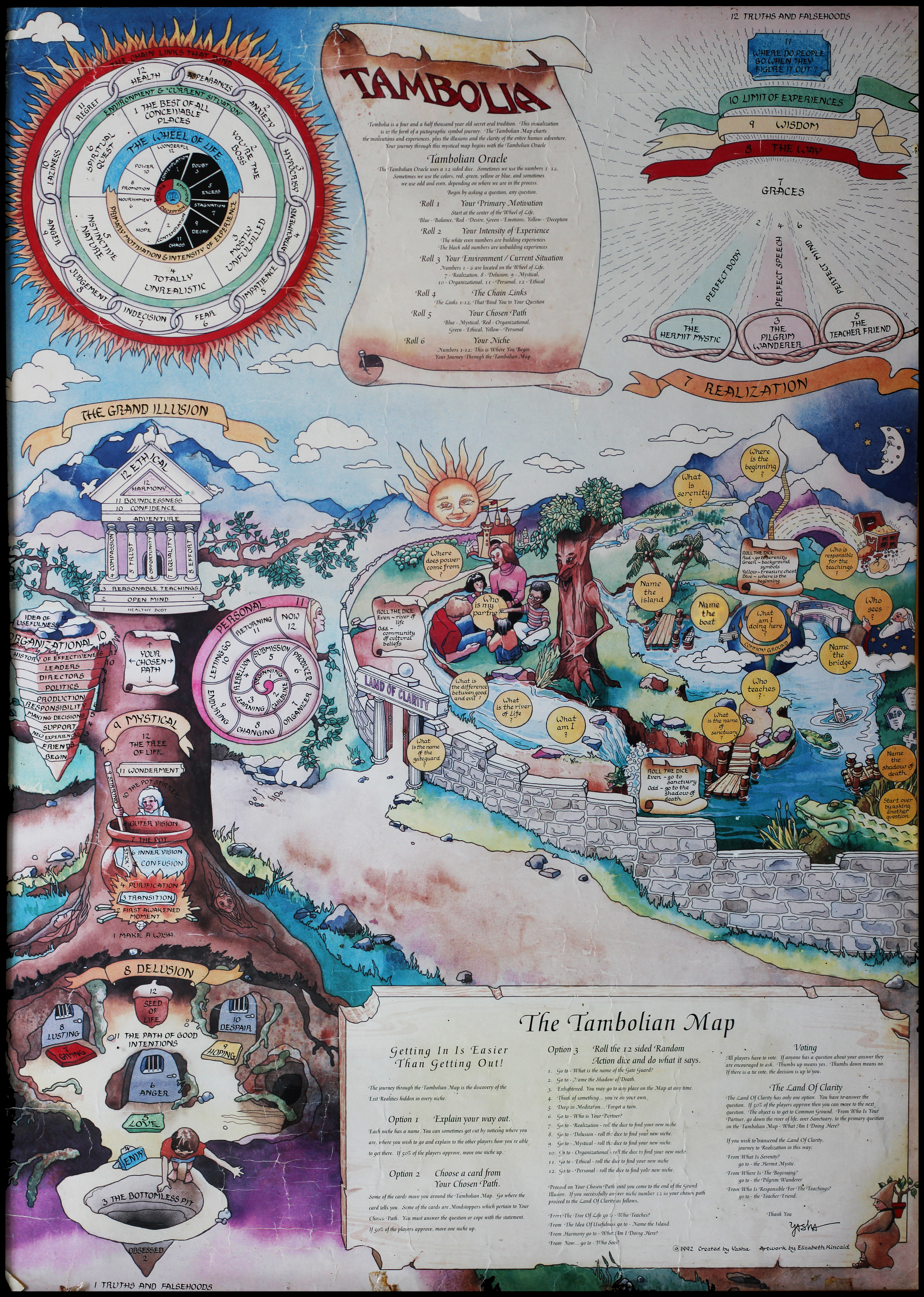
Your journey through the Tambolian Map begins with an Oracle. The Tambolian Oracle uses a dodecahedron, a 12-sided dice. Sometimes, we use the numbers 1-12. Sometimes we use the colors red, green, yellow, and blue, and sometimes we use odd and even numbers, depending on where we are on the Map. Using a deck of poker cards as a random number generator is also possible, though you must eliminate the king.
The Tambolian Oracle explains the initial conditions for your question. It is up to you to uncover the information hidden in those conditions. The Tambolian Oracle encourages you to discover the next step on the path. How you choose the next steps creates the path that eventually takes you to where you are supposed to be.
To begin the Mystical Tambolian Oracle, ask a question.
The Tambolian Map in a Mobile App
Your journey through the Tambolian Map begins with the Oracle. The Tambolian Visualization, as a map of your mind with all the lights turned on, is a two-and-a-half-thousand-year-old secret oral tradition. This Visualization is presented as a pictographic symbol journey. The Tambolian Map charts the motivations, experiences, illusions, and the clarity of the entire human adventure. The Tambolian Oracle uses a 12-sided die - sometimes we use the numbers 1-12, sometimes we use the colors red, green, yellow, and blue, and sometimes we use odd and even numbers depending on where we are in the Map.
The Tambolian Oracle explains the initial conditions for your question. It is up to you to uncover the information hidden in those conditions. The Tambolian Oracle encourages you to choose the next step on the path. You may or may not choose to do so. If you decide to keep choosing the next step in the Tambolian Map, you will eventually get to where you are supposed to be, as many pilgrims have done before you.
You can learn more about The Tambolian Oracle App right here.
What is it?
The Tambolian Map is a transcription of two Tibetan Nyingmapa Buddhist visualizations: the Bhava Chakra (the Wheel of Life) and the Ling Chen Nying Tugue (the Tree of Life). I was given these meditational practices at Padma Ling Temple in Berkeley, California, in the early 1970s. The four Lamas I worked with were DudrupChen Rinpoche, Gyaltrul Rinpoche, Lama Jigtse, and Tarthang Tolku.
The Tibetan Buddhist version of these visualizations is to imagine you live in a dark room. You bump into things you learn very little about. Within this room, life seems complicated, confusing, and often frightening. An epiphany is when a light is turned on in that room. First, you are dazzled. Eventually, you are better able to appreciate the choices you have made and what new options are now available. One also notices windows, doors, and vast spaces filled with memories, dreams, and other things you had forgotten.
These visualizations are thousands of years old and are maintained through the experience and oral traditions of Sadhus, Sages, and Mystics. What they share is that these visualizations are a map of your mind and the human condition with all the lights turned on. What the Tambolian Map does is to organize these visualizations into pictures, symbols, and processes that Western spiritual pilgrims more easily understand.
The Tambolian Map
You can read The Tambolian Map Manual right here